A long read on the animal in the water, the situations people actually meet, the two phone numbers that matter, and how a regulated hunt fits around a living population.
General information checked on November 4, 2026. Fees, dates, and permit rules can change. Your permit and the current Florida Fish and Wildlife Conservation Commission page control a hunt. Official pages open in a new window. Pages on this site stay in this window.
The American alligator, Alligator mississippiensis, is Florida’s state reptile. FWC describes a conservation success: about 1.3 million alligators of every size, living in all 67 counties, in wetlands that offer food and shelter. Serious injuries are rare. A pond behind a house can still hold one. A suburban canal is still alligator habitat when the water, the food, and the cover are there.
An alligator beside fresh water has a home there. It is a freshwater animal that can use brackish water for a while. The National Park Service notes that alligators lack salt-secreting glands and can tolerate salinity briefly. The American crocodile is the animal of south Florida’s salt and brackish mangroves. Florida is the only place where both live in the wild.
From 2012 to 2022, the FWC alligator brochure says Florida averaged eight unprovoked bites a year serious enough to need professional medical treatment. That sentence belongs to the brochure. It is a reason to take the animal seriously, and it is a reason to keep the ordinary rules, because most days near water end with the alligator still an alligator and the person still on the bank.
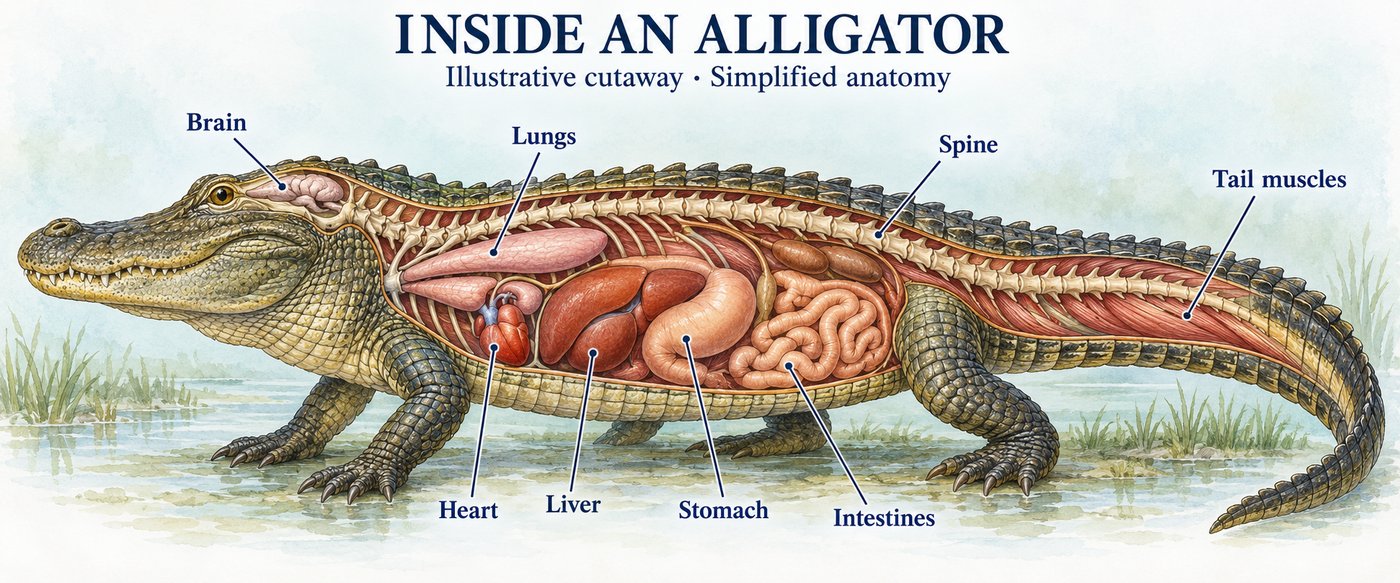
02Inside an alligator
This Is Florida owns the cutaway below. The words printed on the artwork are the content of this section. The title on the drawing is “Inside an alligator.” Under it, the drawing says “Illustrative cutaway · Simplified anatomy.”
Illustrative cutaway. Simplified anatomy. This Is Florida owns this diagram. Read it as a labeled picture. A veterinary reference is a different document.
BrainLabeled in the head, behind the eye.
LungsLabeled along the back, above the other organs.
HeartLabeled in the chest, drawn in red.
LiverLabeled as the large dark organ in the middle of the body.
StomachLabeled beside the liver.
IntestinesLabeled as the coiled tract behind the stomach.
SpineLabeled along the backbone, running into the tail.
Tail musclesLabeled in the long muscular tail behind the hind legs.
Start at the head and follow the spine. A large share of the animal sits behind the hind legs, and the drawing marks that mass as tail muscles. The stomach and the intestines are the digestive tract on the page. The artwork uses one label, Heart. On its facts page, FWC describes a crocodilian heart as four-chambered, with a shunt. The drawing does not diagram those chambers. Eye-shine at night is red, from a tapetum lucidum. FWC also says crocodilians are more closely related to birds than to lizards, snakes, and turtles.
The plates along the back are part of the outside of the animal in the picture. Stay far enough away that you are reading a field guide, or this drawing, for those details. Distance is the identification tool.
03Alligator and crocodile
FWC’s species profile gives the field marks. An alligator has a broad, rounded snout. When the jaw is closed, the lower teeth stay out of sight. Adult alligators are dark gray with a lighter underside. Juveniles have light stripes along the sides. A green cast is often algae on the skin.
An American crocodile has a narrower snout. The fourth tooth on each side of the lower jaw protrudes when the mouth is closed. Crocodiles are brownish gray and generally paler. They live mainly in the brackish and saltwater mangroves of south Florida. Killing or harassing a crocodile is illegal. FWC points people to MyFWC.com/Crocodile, and the same warning is on the Statewide Alligator Program Super Hunt page.
Mark
American alligator
American crocodile
Snout
Broad and rounded
Narrower
Closed jaw
Lower teeth hidden
Fourth lower tooth protrudes on each side
Color
Dark gray, lighter underside. Young animals have light side stripes. Green is often algae.
Brownish gray and generally paler
Where
Freshwater wetlands in all 67 counties. Brackish water for a time.
Mainly south Florida mangroves, brackish and salt
04How big
FWC says females rarely exceed 10 feet, and males grow larger. The state record for length is a male of 14 feet 3 and a half inches, from Lake Washington in Brevard County. The weight record is 1,043 pounds, a male of 13 feet 10 and a half inches, from Orange Lake in Alachua County.
The National Park Service, writing about the Everglades, says adult males occasionally reach 13 to 15 feet and females reach about 10 feet, and that both sexes tend to be smaller in South Florida. Both descriptions stay on this page because both offices published them.
FWC’s hunt tips give a rough length estimate, and it is only an estimate. The inches between the bump on the snout and the eye are roughly the feet of total length. A gap of 4 inches or more between the eyes, when those eyes face a light, often means an adult. Estimating from a bank is a looking skill. Walking up to measure is a different act.
05Water, holes, and a keystone
Everglades National Park describes alligators in swamps, marshes, rivers, lakes, and smaller waters. In the dry season they dig alligator holes. Those holes hold water after the marsh around them dries. Other wildlife uses that water. The park calls the alligator a keystone species for that reason. Nesting also builds peat. Florida red-bellied turtles incubate eggs in active alligator nests and in abandoned ones.
A useful visit is a boardwalk or a marked overlook. Watch how open water, bank, and plants sit together. Notice whether the animal is in the water or on the bank, and whether the marsh is wet or drying. That is the observation. Closing the distance is a separate choice, and the safety section below is the one to use.
Heat, winter, and a still animal
Alligators are ectothermic. They take their heat from the world around them. FWC says they are most active between 82 and 92 degrees Fahrenheit, stop feeding below about 70 degrees, and are dormant below 55 degrees. In winter they use dens or burrows next to an alligator hole or open water, and they still bask on warm days. The National Park Service says foraging ceases below about 68 to 73 degrees. Basking is temperature work. A still animal on a bank is awake enough to be left alone.
What they eat
Diet follows size. FWC says juveniles eat insects, amphibians, small fish, and other invertebrates. Adults eat rough fish, snakes, turtles, small mammals, and birds. They are opportunistic. The park service adds reptiles, including small alligators. A motionless alligator at the edge of the water may be waiting. That is a reason to keep human food, fish scraps, and pet food out of the picture. Feeding is illegal, and it teaches the animal that people are a food stop.
06Nests, eggs, and young
Three public pages describe incubation, and they do not use the same day count. All three stay here, with the office that printed them.
FWC’s species profile: courtship begins in early April, mating is in May or June, the female builds a mound nest, and she lays about 32 to 46 eggs in late June or early July. Incubation is about 60 to 65 days. Hatchlings arrive in late August or early September. Nearly all alligators are sexually mature by about 7 feet. Females can mature at 6 feet. Females mature at about 10 to 15 years, males at about 8 to 12 years. From an average clutch of 35, an estimated 4 reach maturity in a growing population.
FWC’s facts page: the average clutch is 32 to 46 eggs, incubation is about 63 to 68 days, and hatching runs from mid-August through early September. In the survival section of that material, about one third of nests are destroyed by predators, mainly raccoons, or by flooding. An average clutch of 38 yields about 24 live hatchlings if the nest survives. About 10 live to one year. About 8 become subadults at 4 feet. About 5 reach maturity at 6 feet. Eggs are also crushed by the female. Hogs, otters, and bears are reported at nests. Juveniles are eaten by raccoons, otters, wading birds, fish, and larger alligators. Adult deaths include cannibalism, fighting, and human hunting.
The National Park Service Everglades page, updated March 7, 2025: average incubation is 58 to 63 days. Nests are about 3 and a half feet high and twice as wide. Flooding kills most eggs within 12 hours. Sex follows incubation temperature. About 90 to 93 degrees Fahrenheit produces males. About 82 to 86 degrees produces females. Temperatures in between produce a mix. The female opens the nest when she hears the young, and she carries about 8 to 10 hatchlings at a time in her mouth to the water. Pods from different nests may mix. Young stay with the mother typically one year, and sometimes two or three. Growth in the first four years is sometimes more than a foot a year.
A small alligator is a reason to give the bank more room. The mother is often still nearby. This page describes nesting in general. It does not send anyone to a nest.
07Distance, swimming, and food
FWC’s living-with guidance is short because the behavior is simple. Keep a safe distance. Keep pets on a leash and back from the water’s edge. Pets often look like natural prey. Swim only in designated swimming areas, during daylight, and leave the pet out of that swim. Alligators are most active from dusk to dawn. Never feed them. Feeding is illegal and dangerous.
The National Park Service says most attacks on people are tied to illegal feeding, and that feeding or provoking alligators and other wildlife is illegal. The agency pages used for this guide do not print a fixed number of feet as a statewide standoff distance. “Safe distance” is the phrase they use. When the animal feels close, add space and leave on the path you came in on.
A bite or a scratch, even a small one, can cause a serious infection. Get medical care right away. If a person is hurt, call 911 for the person, then 866-392-4286 for the animal.
08Children and pets
Decide the standing place before anyone leans over the bank. Children stay with an adult, on the visitor side of a rail or a mowed edge. Zoom on a camera does the work that footsteps would do. Leave a clear path back to the car or the trail.
FWC’s pet guidance uses a non-retractable leash of 6 feet or less, especially at dusk, dawn, and night. Dogs and cats stay out of the water’s edge. They do not swim in fresh or brackish water. Pet food does not sit outside unattended. A dog is not chained where food is. Those habits match the way an alligator hunts: low, at the edge, at the hours when people are tired and pets are off a routine.
A child’s ball in the water is a retrieval problem for an adult with a tool, from a distance, or it is a lost ball. Wading in after it puts a person in the hunting lane. The same is true of a dog toy.
09Situations, with the nuance
People meet alligators in a handful of repeating scenes. The phone number is often the same. The reason for the call changes. FWC’s Statewide Nuisance Alligator Program, called SNAP, prints the sorting rule.
In a pool, garage, or porch
Call 866-FWC-GATOR. Alligators in swimming pools, garages, porches, or similar places are removed, including animals under 4 feet. You do not move it yourself. Handling is illegal, and a bite can infect.
Four feet, and you believe it is a threat
SNAP generally treats an alligator as a nuisance when it is at least 4 feet long and the caller believes it threatens people, pets, or property. The hotline takes the report. If the complaint qualifies, SNAP issues a permit to a contracted trapper.
Under four feet, in the water
FWC says an alligator under 4 feet is not large enough to be a danger to people or pets unless someone handles it. Leave it. A small animal in a pool or a garage is the earlier card, and that one is a call.
Basking on the bank
Heat-seeking, including on a cool morning that has turned sunny. The animal can move. Give it the bank. Photograph from the path. A crowd that walks the waterline is the problem that grows.
A dog at the pond
Leash, 6 feet or shorter, non-retractable. Away from the edge. No swimming in fresh or brackish water. No food left out. No dog chained at a food spot. The silhouette of a dog at dusk is prey-shaped.
Someone is feeding one
Feeding and enticement are illegal. Use Wildlife Alert, 888-404-3922, #FWC, or the online report. The nuisance line is for the animal that is already a safety problem. The alert line is for the violation.
You want it moved to a swamp
FWC does not relocate nuisance alligators. The published reasons are a healthy population, a habit of returning, and the social structure already living at remote release sites. Putting a new animal into that structure can mean fighting and death.
A community pond or private land
If a complaint qualifies, the caller has to give the trapper legal access. SNAP does not permit removal from private property, or from property a public agency manages, without permission from the owner or the managing authority.
Red eyes after dark
That shine is the tapetum, and FWC says it is red. Dusk to dawn is the active window. Stay off the waterline. Swim only in a designated area, in daylight.
A bite or a scratch
911 for the person. Then 866-392-4286 for the animal. Seek medical care the same day. Infection is the medical issue FWC names, including for a wound that looks minor.
Hatchlings or a mound nest
More room, not a closer look. Females stay near the nest and answer the young. Posting a pin for a nest sends a crowd to a breeding animal. Learn the behavior here, or from a park program at a managed overlook.
A cold, quiet alligator
Below about 55 degrees they are dormant. Below about 70 they stop feeding. They still bask when the day warms. Stillness in January is the same viewing rule as stillness in July.
10Who picks up the phone
SNAP’s first job is public safety. The aim is to deal with threats in developed areas and to keep alligators where they naturally live. The statewide number is 866-FWC-GATOR, which is 866-392-4286. When a call qualifies, FWC sends a contracted nuisance-alligator trapper.
Have the place ready when you call: the address or the park name, the kind of water, about how long the animal looked, what it is doing, and whether people or pets are close. If you can see it from a safe spot, stay there until you are told otherwise. Chasing it back into the water, or into a neighbor’s yard, changes the call.
Wildlife Alert is the other number
Wildlife Alert is 888-404-FWCC, which is 888-404-3922. From a cell phone, #FWC reaches the same kind of report. The online form is on FWC’s Wildlife Alert page. Call or file as soon as you can. Useful details are the location, what people did, vehicles, and tag numbers.
If a tip leads to an arrest or a citation, a reward of up to $1,000 may be available. The reward schedule is separate from the criminal fine. On that schedule, Level One examples include hunting, fishing, or trapping without a license, and the listed reward is $100. Level Two includes feeding or enticement of alligators or crocodiles, and the listed reward is $300. Those dollar figures are rewards for information. They are not the penalty imposed on the person who broke the rule.
A pond alligator that concerns you is the nuisance line. A person tossing food, or a person killing an alligator outside the permit rules, is Wildlife Alert.
Signs you can post
The SNAP page links “Don’t Feed” and “Be Alert” signs as PDFs, and it links an alligator brochure. The brochure address is on the source list. A sign is a reminder for guests. It does not replace the phone call when an animal is already in a pool or on a porch.
11Protection, and what still threatens them
The National Park Service notes that the American alligator was listed as endangered in 1967 under the law that came before the Endangered Species Act, and that it was removed from the endangered list in 1987. FWC’s facts page explains the status that followed. The U.S. Fish and Wildlife Service lists the alligator for its similarity of appearance to a threatened animal, the American crocodile. Florida adopted that listing. Alligators may be taken legally only with the licenses and permits the Commission requires.
FWC names wetland destruction as the main threat. The management goal on the facts page is the long-term well-being of the population and the benefits that population gives people. Regulated hunting sits inside that goal. An unpermitted kill sits outside it, under section 379.409, which is in the law section below.
FWC also publishes a children’s education page on alligators, a Private Lands Alligator Program, and an alligator farming program. This guide names them and sends you to FWC for the current rules of each one. The farming license fee that appears in statute is covered with section 379.3751 below, because that dollar amount is printed in the statute itself.
12Regulated hunting
This section describes the public hunt as FWC published it. It is general information checked on November 4, 2026. It is not a set of instructions for killing an alligator, and it does not replace a permit. Gear, bait, and shot placement are left on FWC’s own pages.
The statewide harvest page sets the season from August 15 through November 1. A permit allows two alligators. An applicant must be at least 18 years old by August 15 of the application year, and must be clear of a conviction for section 379.3015, section 379.409, or Commission rules on the illegal taking of any crocodilian. The bar is 5 years, or 10 years if the conviction involved an endangered crocodilian.
Countywide permits are offered in 65 of the 67 counties. Miami-Dade and Monroe are the two counties outside that countywide offer. FWC tells applicants to know the water before they apply. Applications go through a county tax collector, a license agent, or Go Outdoors Florida. This page does not print a statewide application fee, because that figure was not confirmed on an FWC page during this check. The Super Hunt fees below were copied from FWC’s Super Hunt page on November 4, 2026, and they can change.
Published seasonAugust 15 – November 1
The statewide season printed by FWC. Two alligators on a permit. On November 4, 2026, that published end date has passed for the regular statewide season.
Order EO 26-38November 2 – November 8, 2026
Four units only, for people already permitted under rule 68A-25.042 for those units. The order was signed in October 2026. It expires December 31, 2026.
Super HuntAugust 15 – December 31
For a person drawn for a Super Hunt permit, on included management units. The 2026 application window was May 8 through June 8.
The four-unit extension that is still open on this date
Executive Order EO 26-38 extends harvest from November 2 through November 8, 2026, only for persons permitted under 68A-25.042 for these areas: St. Johns River Palatka South (AMU 507), Three Lakes Wildlife Management Area (AMU 549), Lake Okeechobee South (AMU 604), and Bay County (AMU 803). Unused CITES tags under that order are returned no later than November 23, 2026. The order does not override an access closure. The rest of the harvest rules remain. Because this page was checked on November 4, 2026, those four units can still sit inside the extension. The permit, and the current FWC page, decide whether a particular hunter is inside it.
Harvest periods on the regular permit
FWC splits the early season into four periods, then opens a shared late window. If both alligators are not taken in the assigned week, the remaining open period is September 12 through November 1.
Period
Assigned week
Shared window
P1
August 15–21
September 12–November 1
P2
August 22–28
September 12–November 1
P3
August 29–September 4
September 12–November 1
P4
September 5–11
September 12–November 1
On most areas, hunting is allowed 24 hours a day. The clock starts at midnight on the first day and ends at 11:59 p.m. on the last day. Stormwater treatment areas and the A-1 FEB are different: 5 p.m. to 10 a.m., and those units are weekend-only except as the permit says.
A harvest has to be logged within 24 hours, or before the alligator goes to a processor, whichever comes first. If the hunter is out of cell service, FWC provides a temporary transfer log. The Fish | Hunt FL app is part of that reporting path. CITES tags and an alligator trapping license are required.
Super Hunt, which is a second drawing
Super Hunt does not replace the statewide program. A person can be drawn for both. For 2026, applications ran from May 8 through June 8 at Go Outdoors Florida. The fee on that page is $5 an application. A person may apply more than once. One Super Hunt permit is issued per year. The permit allows up to two alligators. FWC anticipates about 5 to 100 permits a year.
A selected permittee may hunt most legally accessible alligator management units from August 15 through December 31. Seventeen units are excluded: 109, 112, 406, 407, 408, 413, 414, 415, 416, 417, 507, 543, 544, 546, 547, 721, and 741. AMU 507 is on that excluded Super Hunt list. AMU 507 is also one of the four units in Executive Order EO 26-38 for the regular program. Those are two different permissions. Read the permit in your hand.
If selected, the resident charge printed for the trapping license, the permit, and two CITES tags is $272. The non-resident charge is $1,022. A second pair of CITES tags, for someone in both hunts, is an additional $62. A Florida Resident Persons with Disabilities Hunting and Fishing License removes the trapping-license fee and prices two CITES tags at $22. Residents over 65 who need to renew that disability license are told to contact FWC before applying, so the $272 charge does not land by mistake. Questions on the Super Hunt page go to 352-620-7729. Unused Super Hunt CITES tags go to the Alligator Management Program, 1239 SW 10th Street, Ocala, FL 34471. Reporting is within 24 hours, or before a processor takes the animal.
On November 4, 2026, a person who was drawn for Super Hunt can still be inside the August 15 through December 31 window, on an included unit, if the permit and access rules say so.
On the water, after dark
FWC’s hunt-safety page tells boaters to follow Florida boating rules, to show navigation lights at night, and to carry a wearable life jacket for each person. FWC recommends that everyone wear one. Any bite needs medical care. At night, keep voices down, keep lights off houses, move a carcass discreetly, and do not dump a carcass in the water or on the roadside.
Section 379.409 makes it illegal to intentionally kill, injure, possess, or capture an alligator or other crocodilian, or their eggs, or to attempt those acts, unless Commission rules authorize it. Equipment used in the offense may be confiscated on conviction. A violation is a Level Four violation under section 379.401. Section 379.401 says a Level Four violation is a third-degree felony, punishable as provided in sections 775.082, 775.083, or 775.084. This page does not add a prison term or a dollar fine on top of that cross-reference. The statute pages below are the text.
Section 379.412 prints its own ladder. A first violation is a noncriminal infraction with a civil penalty of $100. A second alligator or crocodilian-related violation is a second-degree misdemeanor. A third is a first-degree misdemeanor. A fourth or later violation is a third-degree felony. This page does not invent jail days for those steps. Leaving scraps where an animal can find them is a reason to stop and to read 379.412. It is not, by itself, a statement that a particular scrap pile is already the $100 infraction. The statute and the facts of the place do that work.
Section 379.3751 requires the alligator license before a person takes or possesses an alligator or eggs. The license is valid for 12 months. The statute sets the annual fee for a farming license at $250. That figure is the farming-license fee in the statute. A person convicted under 379.3015 or 379.409, or for an illegal crocodilian take, cannot be issued a license for 5 years, or for 10 years if an endangered crocodilian was taken. Violating 379.3751 is a Level Two violation under 379.401.
A longer laws page on this site stays in this window: Florida laws.
14Questions people ask
Are they only in the Everglades?
FWC counts alligators in all 67 counties, in wetlands with food and shelter. The Everglades are famous habitat. They are not the whole map. About 1.3 million animals of every size is the figure FWC has used in its safety news.
Is a basking alligator tame?
Basking is how an ectothermic animal warms up. FWC describes activity peaking from 82 to 92 degrees, feeding slowing under about 70, and dormancy under 55, with basking still happening on warm winter days. The National Park Service puts the end of foraging near 68 to 73 degrees. None of those numbers is permission to approach.
What do I do about one in the pool?
Call 866-392-4286. Pools, garages, porches, and similar places are removal calls even when the alligator is under 4 feet. Keep people and pets inside while you wait. Do not handle it.
Can FWC move it to a remote lake?
SNAP says FWC does not relocate nuisance alligators. The reasons on that page are a healthy population, animals that return, and the harm of dropping an alligator into a place where other alligators already have a social order.
Who do I call if someone is feeding them?
Wildlife Alert: 888-404-3922, #FWC from a cell, or the online report. Give the place and a description as soon as you can. The reward schedule is separate from the fine. Level Two on that schedule includes feeding or enticement of alligators or crocodiles.
Is the 2026 hunt closed on November 4?
The published statewide season runs August 15 through November 1. Executive Order EO 26-38 then extends November 2 through November 8, 2026, only for permitted hunters on four named units: AMU 507, AMU 549, AMU 604, and AMU 803. A drawn Super Hunt permit can run through December 31 on included units. The piece of paper in the hunter’s name, and the current FWC page, are the decision. This paragraph is the public calendar as checked on November 4, 2026.
Can I hunt in Miami-Dade or Monroe on a countywide permit?
FWC’s countywide permits cover 65 counties. Miami-Dade and Monroe are the two that are outside that offer. Know the water before you apply anywhere else, because the permit is tied to a place.
How do I tell a crocodile without getting close?
From a distance, use the snout and the tooth line. Alligator: broad rounded snout, lower teeth hidden when the mouth is shut. Crocodile: narrower snout, fourth lower tooth sticking up on each side when the mouth is shut. South Florida mangroves are where the crocodile question comes up. When you are unsure, treat the animal with the same distance you would give an alligator, and leave crocodile harassment off the list of options. It is illegal.
Where should a first look happen?
A park or a nature center with a boardwalk and a current notice at the gate. This page describes the animal. It does not certify that a named trail is open today. Check the park before you go.